
Top 10 Mistakes CEED Aspirants Make Without Coaching
Every year, I see talented, driven students walk into CEED preparation with full confidence and walk out disappointed. Not because they lack creativity or intelligence. But because they made the same avoidable mistakes that nobody warned them about.
As someone who has guided design aspirants for years, I can tell you this with certainty: winging your CEED preparation without a structured approach is one of the costliest decisions you can make. The Common Entrance Examination for Design is not just an art test. It is a rigorous evaluation of your visual thinking, analytical reasoning, and design sensibility. Without proper direction, most self-preparing students fall into predictable traps.
Here are the ten most common mistakes I see CEED aspirants make when they go at it alone.
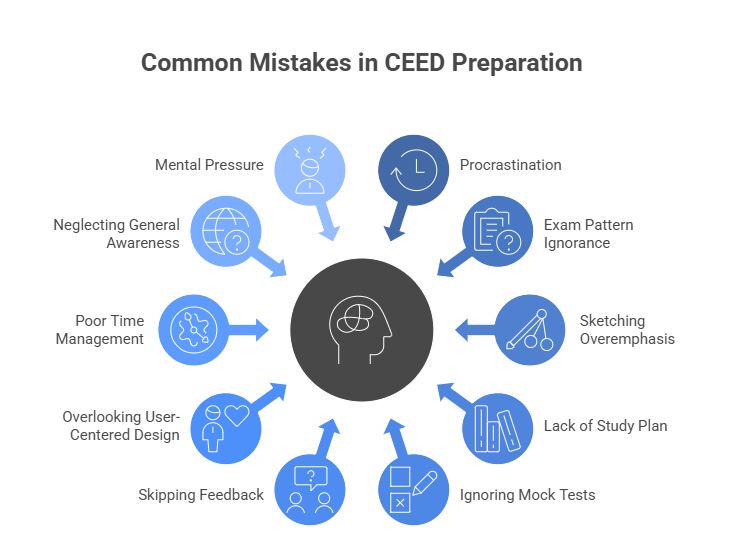
1. Procrastinating on Starting Preparation
This is the mistake I see most often, and it is the one that causes the most damage. Students convince themselves they have enough time, keep pushing their start date, and before they know it, the exam is three months away with half the syllabus untouched.
CEED preparation is not something you can cram in the final weeks. It requires you to build habits over months. Sketching fluency does not happen overnight. Visual reasoning sharpens over time. Start early, build daily routines, and respect the timeline.
2. Not Understanding the Exam Pattern
Many students study with passion but without direction. They do not take the time to understand what CEED actually tests. The exam has two distinct parts. Part A is a computer-based screening that evaluates logical reasoning, visual ability, environmental and social awareness, and language skills. Part B is a subjective test that assesses your drawing ability, creativity, and problem-solving through design tasks.
When you do not understand this structure, you end up over-preparing for one section while completely ignoring the other. Know what you are preparing for before you prepare.
3. Treating CEED as Only a Sketching Test
This is a mindset error I see repeatedly among self-preparing students. They pour all their time into sketching practice and assume that strong drawing skills will carry them through. While sketching is important for Part B, Part A carries significant weight and involves no sketching at all.
Visual perception, observation-based questions, logical sequences, and design sensitivity questions in Part A require dedicated preparation. Neglecting this section because it feels less glamorous is a very common and very costly mistake.
4. Having No Study Plan or Schedule
Preparation without a plan is just wishful thinking. Without CEED coaching or external accountability, most students fall into an unstructured routine of studying whatever they feel like on a given day. Some weeks they sketch obsessively. Other weeks nothing happens at all.
A proper CEED preparation plan breaks the syllabus into manageable portions, assigns time to each topic, schedules mock tests, and builds in revision windows. Without this kind of structure, you will always feel like you are studying but never feel truly prepared.
5. Ignoring Mock Tests and Previous Year Papers
I cannot stress this enough. Past papers are among the most valuable resources a CEED aspirant has access to, and yet self-preparing students tend to treat them as optional extras rather than core preparation tools.
Mock tests condition your mind for the actual exam. They expose your weak spots, build time management skills, and reduce exam anxiety. Previous year papers reveal the patterns in question types, the difficulty level you should aim for, and the areas that are repeatedly tested. Not doing these consistently is simply leaving marks on the table.
6. Skipping Feedback on Their Work
When you study alone, there is no one to tell you that your sketches lack proportion, your design thinking is off-track, or your approach to a problem misses the point. Self-assessment has real limits.
Design, at its core, is a communicative discipline. Your work needs to be understood by others. Without feedback from a mentor, a coach, or peers who understand the exam, you can spend months reinforcing the wrong habits. Getting objective, informed feedback on your work is something self-preparation rarely provides.
7. Overlooking User-Centred Design Thinking
CEED evaluators are not just looking for beautiful drawings. They are looking for evidence that you think like a designer, which means thinking about people. User-centered design is the principle that every design solution should address, a real human need with empathy and practicality.
Many students approach Part B questions purely from an aesthetic angle. They focus on how something looks rather than why it works, who it serves, and what problem it solves. This is a fundamental gap that coaching helps close by teaching you, how to frame and approach design problems the way IIT evaluators expect.
8. Poor Time Management During the Exam
Knowing the material is only half the battle. Being able to deliver it within the exam's time constraints is the other half. This is a skill that has to be practised deliberately.
Students who prepare without mock test simulations often find themselves running out of time in Part B, leaving questions incomplete, or spending too long on a single sketch. Time allocation under exam conditions does not come naturally. It comes through repeated timed practice, and that practice is something many self-preparing students skip.
9. Neglecting General Awareness and Cultural Sensitivity
CEED Part A includes questions that test your awareness of the world around you. Design history, notable designers, everyday objects, social and environmental contexts, and cultural design references are all fair game. These are the kinds of questions that demand broad, continuous reading and exposure over many months.
Self-preparing students often underestimate this area because it does not feel as tangible as sketching practice. They leave it for the last few weeks and then scramble to cover it. Building general design awareness is a long-term habit, not a last-minute exercise.
10. Underestimating the Mental Pressure Without Support
This one rarely gets talked about, but it is very real. Preparing for a competitive entrance exam alone is mentally taxing. There is no one to answer your questions when you are stuck, no one to keep you accountable when your motivation dips, and no one to reassure you when self-doubt creeps in.
Coaching provides not just knowledge but also a support structure. Having a mentor who has seen hundreds of students through this process, who knows when to push and when to encourage, makes a significant difference in how consistently and confidently you prepare.
Turn Your CEED Dream into Reality with the Right Guidance
CEED is absolutely crackable. But cracking it without guidance requires extraordinary self-discipline, self-awareness, and a very structured approach. Most students, however talented, find that the combination of a solid mentor, a structured curriculum, and continuous feedback is what makes the real difference between a near-miss and a qualified rank.
If you are serious about getting into an IIT for design, do not leave your preparation to chance. Invest in the right coaching, the right feedback, and the right preparation environment.
At afdindia, we have been preparing design aspirants to crack competitive entrance exams with structured coaching, expert mentorship, and a curriculum built around what actually works. If you are ready to take your CEED preparation seriously, we are here to make sure every step you take is a step in the right direction.
India's No.1 Design Coach
Julie James
Helping students crack NIFT, NID, UCEED & CEED since 1999!
Ms Julie James has been mentoring students to crack design entrance exams such as NIFT, NID, UCEED, CEED & NATA since 1999. A post-grad from NIFT- New Delhi, Ms. James has 25+ years of experience in design education. She has worked in the fashion industry in various capacities after her graduation. As HOD, she has been instrumental in setting up the fashion design department at Assumption College under MG University. At afdindia, she coordinates academics and designs curricula based on the latest changes in question paper patterns. Her creative teaching methods have enabled the institute to achieve great success rate.

Hostels
Take the AFDSAT
get upto 90% scholarship







Kochi Center
3rd Floor, MI arcade, NH 47, Near Metro pillar 381, Edappally Toll, Ernakulam, Kochi, Cochin
Ph: 9895484652
Kannur Center
2nd Floor, Emarald Complex,
Kakkad Road, South Bazzar, Kannur,
Ph: 9895484651
Calicut Center
2nd Floor, City Tower,
Mavoor Road, Kozhikode
Ph: 9895484651