
What After 10th: How to Start Design Preparation Early?
Every year, I meet hundreds of students who walk into our institute wide-eyed and eager. Many of them discover design only after their 12th board exams. They spend those crucial two years without preparation and are then forced to cover in months what should have been built over years.
So let me say this directly, as someone who has guided thousands of aspiring designers into some of India's most prestigious design schools, if you have just cleared your 10th standard and feel that pull toward creativity, toward sketching, styling, or shaping spaces, do not wait. Start now. The students who consistently crack NIFT, NID, and UCEED are not necessarily the most naturally gifted. They are the ones who started earliest.
Why the Window After 10th is so Valuable
In my experience as a design coach, the biggest differentiator between students who get into top institutes and those who don't is rarely talent, it is preparation time. The skills tested in design entrance exams cannot be crammed overnight. They are cultivated gradually through daily practice and consistent exposure.
The two years between Class 10 and Class 12 are arguably the most underutilised years in a design aspirant's journey. While entrance exams like NIFT, NID DAT, and UCEED are written while pursuing the 12th, the groundwork for cracking them must begin well before. Think of it this way: a student who has been sketching daily for two years walks into the exam hall with a completely different kind of confidence than someone who picked up a pencil three months ago.
Choosing the Right Stream in Class 11
One of the first things students and parents ask me is: "Which stream should we choose?" My answer is always nuanced, because design is a broad field.
Design entrance exams in India accept students from any stream, such as science, commerce, or arts. However, if your interest leans toward fashion design, graphic design, or interior design, the Arts stream offers the most natural alignment. It immerses you in aesthetics, visual culture, and creative thinking from day one.
On the other hand, if product or industrial design excites you, especially the kind of work involved in creating a phone, a vehicle, or a piece of furniture, a background in science, combined with strong spatial reasoning and a solid grasp of physics, can work to your advantage.
Know the Landscape Before You Dive In
I always tell my students: before you prepare, understand what you are preparing for. Design is not a single discipline; it is a diverse ecosystem of creative fields. Here are the major ones worth knowing:
Fashion Design covers garment construction, textiles, styling, and the entire lifecycle of clothing and accessories. Graphic Design deals with visual communication: logos, typography, branding, and digital media. Interior Design transforms physical spaces, making them both functional and beautiful. Product and Industrial Design focuses on the objects around us, how they look, how they work, and how they feel in the hand. Communication Design sits at the intersection of visuals and storytelling, combining imagery with language to convey ideas.
The Exams You Are Working Toward
Let me give you a clear picture of the finish line, so your preparation has direction.
NIFT, the National Institute of Fashion Technology, is one of the most sought-after design entrance exams in India. It features situation-based questions that test practical design thinking and creative judgment. NID DAT, the entrance exam for National Institute of Design campuses across India, has two phases: written prelims and a studio-based mains with an interview. UCEED, conducted by IIT Bombay, tests visualisation, observation, and analytical skills, and opens doors to B.Des programmes at IITs in Bombay, Delhi, Guwahati, Hyderabad & other reputed institutions.
None of these exams reward mugging up facts. They reward genuine creative development. Which is exactly why I push my students to begin early.
What I Tell Every Student Who Walks Into My Coaching Room
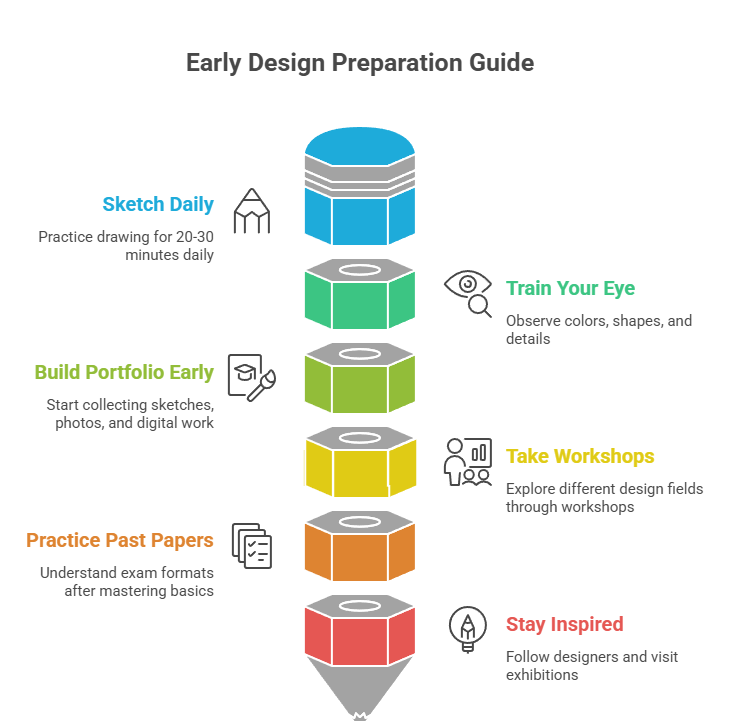
1. Make Sketching Non-Negotiable
2. Train Your Eye, Not Just Your Hand
One of the sections most students underestimate in design entrance exams is observation-based assessment. In my sessions, I consistently coach students to look at the world differently to notice the proportions of a building facade, the colour palette of a market street, and the way fabric folds under light. This is not abstract advice. It is a trainable skill, and the students who practise it consciously over months develop a visual vocabulary that shows up powerfully in their exams.
3. Build Your Portfolio From Day One
Several top institutes, including NID, IITs, and ISDI, treat the portfolio as a critical component of selection. I have seen portfolios built in a panic over two weeks, and I have seen portfolios that represent two years of genuine creative exploration. The difference is unmistakable to any evaluator. Start now. Include sketches, photographs, digital work, craft projects, anything that reflects your thinking. Let it grow with you.
4. Supplement With Short Courses and Workshops
5. Work With Past Papers Strategically
6. Stay Immersed in the Design World
Mistakes I See Aspiring Designers Make (And How to Avoid Them)
After years of coaching, certain patterns of error repeat themselves. The most common ones: waiting until Class 12 to pick up a sketchbook, ignoring general awareness and material culture which appear in exam syllabi, building a portfolio hastily in the weeks before submission, and narrowing their focus to one discipline too soon, before they have explored enough to know what truly fits them.
Avoid these. The students who sidestep these traps are the ones, whose admit letters I get to celebrate.
A Final Word from the Coaching Room
In all my years of guiding design aspirants, I have never met a student who regretted starting early. Not once. But I have met many who wish they had.
Design is one of the most meaningful and future-proof careers a creative person can choose. It combines art with problem-solving, aesthetics with utility, and individual vision with real-world impact. If that resonates with you, then your preparation begins today, not tomorrow, not after the next exam, not after 12th.
If you are looking for structured guidance and a learning environment that truly nurtures design talent at every stage, I would strongly recommend exploring afdindia. Our programmes are built for students who are serious about design offering a clear pathway from foundational skill-building to advanced specialisation, with mentorship that meets students exactly where they are.
India's No.1 Design Coach
Julie James
Helping students crack NIFT, NID, UCEED & CEED since 1999!
Ms Julie James has been mentoring students to crack design entrance exams such as NIFT, NID, UCEED, CEED & NATA since 1999. A post-grad from NIFT- New Delhi, Ms. James has 25+ years of experience in design education. She has worked in the fashion industry in various capacities after her graduation. As HOD, she has been instrumental in setting up the fashion design department at Assumption College under MG University. At afdindia, she coordinates academics and designs curricula based on the latest changes in question paper patterns. Her creative teaching methods have enabled the institute to achieve great success rate.

Hostels
Take the AFDSAT
get upto 90% scholarship







Kochi Center
3rd Floor, MI arcade, NH 47, Near Metro pillar 381, Edappally Toll, Ernakulam, Kochi, Cochin
Ph: 9895484652
Kannur Center
2nd Floor, Emarald Complex,
Kakkad Road, South Bazzar, Kannur,
Ph: 9895484651
Calicut Center
2nd Floor, City Tower,
Mavoor Road, Kozhikode
Ph: 9895484651