
CAT vs GAT: Which Section Matters More in NIFT?
What exactly are CAT and GAT?
Before we compare them, let us understand what each test is truly testing.
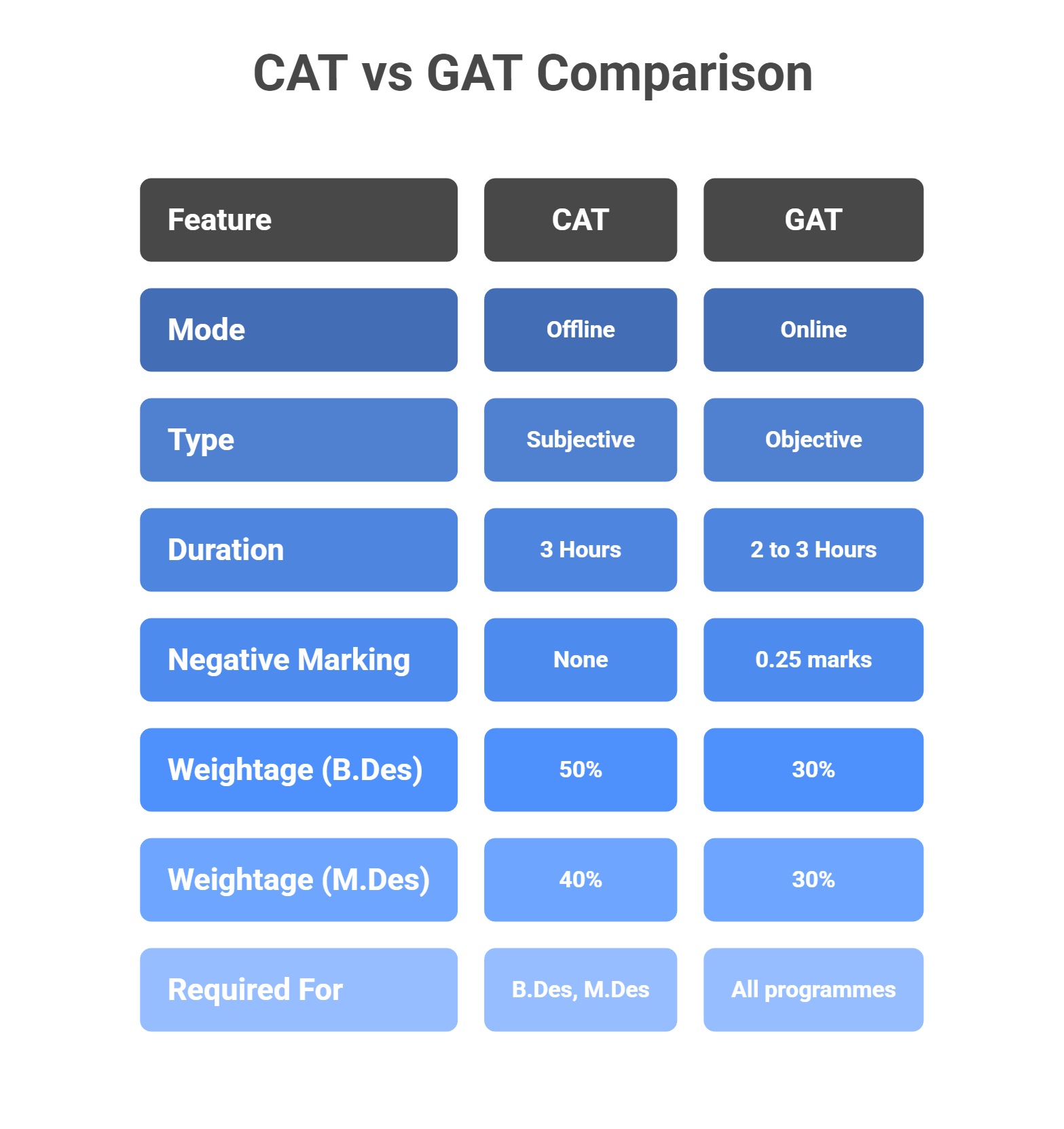
The Creative Ability Test (CAT) is an offline, paper-based exam conducted over three hours. It is a subjective drawing test with no negative marking, designed to evaluate your imagination, observation, concept development, illustration ability, and creative use of colour. There are typically three questions, and the entire paper is about how well you can think visually and present original ideas on paper.
The General Ability Test (GAT), on the other hand, is a computer-based objective test. It covers five key areas: quantitative ability, communication ability, English comprehension, analytical and logical ability, and general knowledge and current affairs. Unlike the CAT, the GAT does carry a negative marking of 0.25 marks for every wrong answer, so you need to be strategic about which questions you attempt.
Both are compulsory for B.Des and M.Des applicants. If you are applying for B.F.Tech, however, you only need to appear for the GAT.
The Weightage: Where the Numbers Tell the Story
Here is where I always ask my students to pay close attention, because this is the single most important factor in answering the "which matters more" question.
For B.Des admissions, the CAT carries a weightage of 50%, the GAT carries 30%, and the Situation Test makes up the remaining 20% of your final score.
For M.Des admissions, the CAT holds 40% weightage, the GAT accounts for 30%, and the personal interview carries 30%.
For B.F.Tech, the GAT alone determines 100% of the written examination score since there is no CAT requirement.
The numbers speak clearly. If your goal is a B.Des or M.Des seat at NIFT, the CAT is the heavier lifter. It is not even close. But here is what I tell every student who uses this as a reason to neglect GAT: a 30% weightage is not something you can afford to dismiss. A weak GAT score can absolutely cost you your seat, no matter how brilliantly you have performed in CAT.
CAT: The Section That Separates the Artists from the Aspirants
I have always believed that CAT is the soul of the NIFT exam. It is where NIFT checks whether you have what it takes to think like a designer.
The CAT syllabus covers design theory, colour terminology, composition, theme development, imagination, and visualisation. You are not just being tested on whether you can draw; you are being tested on whether you can think creatively under pressure and communicate that thinking through visual means.
What makes CAT preparation unique is that there is no shortcut through rote learning. You cannot memorise your way through a drawing paper. What you can do is develop your observational skills, practice sketching daily, expand your colour sense, and work on your ability to tell a visual story within a limited time frame. The students I have coached who perform best in CAT are the ones who treat creativity as a discipline, not just a talent they were born with.
One important thing to remember: since CAT has no negative marking, you must attempt every single question. Do not leave anything blank. Even an imperfect attempt is better than no attempt at all.
GAT: The Section You Cannot Ignore
Here's a mistake I see far too frequently. A student who is naturally artistic decides to put all their energy into CAT and barely touches GAT. They walk out of the exam hall feeling confident, only to see their final merit rank suffer because their GAT score pulled them down.
The GAT tests you across five distinct areas, and each one requires a different kind of preparation. Quantitative ability covers basic arithmetic, percentages, and number systems. Communication ability and English comprehension test your language skills and reading speed. Analytical and logical ability checks how well you can reason through problems. General knowledge and current affairs are arguably the trickiest because they demand consistent, long-term reading habits rather than last-minute cramming.
Because the GAT is an objective paper with negative marking, your strategy matters as much as your knowledge. I always advise my students to attempt questions they are confident about first, flag uncertain ones, and skip questions where they are purely guessing.
The GAT also carries 100% weightage for B.F.Tech students, which means if you are aiming for a fashion technology programme, this is your entire battleground.
So, Which One Matters More?
The answer depends entirely on which programme you are targeting.
If you are aiming for B.Des or M.Des, CAT matters more in terms of weightage. It is the section that will make or break your rank. But GAT is not optional. Think of it this way: CAT gets you noticed, but GAT secures your seat.
If you are targeting B.F.Tech, GAT is everything. There is no CAT involved, and your entire written examination score comes from your performance in this single paper.
My advice to every student is this: do not build a preparation strategy around what matters more. Build it around what you are weaker in. If you are already a confident sketcher but your general knowledge is patchy, you already know where to invest your time. The NIFT merit list is unforgiving, and a lopsided preparation will show up in your final rank.
Practical Tips to Balance Both Sections
Over the years, I have refined a preparation approach that helps students give both sections their due attention without burning out.
For CAT, practise sketching every single day without exception. Work on memory drawing, observation exercises, and timed creative prompts. Study colour theory and design principles seriously. Look at reference images, architecture, nature, and everyday objects with the eye of a designer.
For GAT, build a daily reading habit using newspapers and design-related publications to sharpen your general knowledge. Revise quantitative concepts from the foundational level. Practice English comprehension passages under time pressure. Solve previous years' GAT question papers regularly, as they reveal the pattern and tone of questions very accurately.
Most importantly, attempt full-length mock tests that combine both CAT and GAT. This trains your mental stamina and helps you understand how to pace yourself across a demanding examination day.
In Conclusion
The debate between CAT and GAT is, in my experience, a bit of a false choice. The NIFT entrance examination is designed as a holistic assessment of whether you have both the creative instinct and the intellectual foundation to thrive in a demanding design programme. Excelling in one while ignoring the other is a strategy that rarely works.
If you are serious about securing a seat at NIFT, you need structured, expert-guided preparation for both sections. At afdindia, students receive specialised coaching that addresses both the creative demands of CAT and the academic rigour of GAT, giving aspirants the comprehensive edge they need in one of India's most competitive design entrance examinations. With the right guidance, a clear understanding of the exam structure, and consistent practice, cracking NIFT is absolutely within your reach.
Start early, prepare smart, and never underestimate either section.
India's No.1 Design Coach
Julie James
Helping students crack NIFT, NID, UCEED & CEED since 1999!
Ms Julie James has been mentoring students to crack design entrance exams such as NIFT, NID, UCEED, CEED & NATA since 1999. A post-grad from NIFT- New Delhi, Ms. James has 25+ years of experience in design education. She has worked in the fashion industry in various capacities after her graduation. As HOD, she has been instrumental in setting up the fashion design department at Assumption College under MG University. At afdindia, she coordinates academics and designs curricula based on the latest changes in question paper patterns. Her creative teaching methods have enabled the institute to achieve great success rate.

Hostels
Take the AFDSAT
get upto 90% scholarship







Kochi Center
3rd Floor, MI arcade, NH 47, Near Metro pillar 381, Edappally Toll, Ernakulam, Kochi, Cochin
Ph: 9895484652
Kannur Center
2nd Floor, Emarald Complex,
Kakkad Road, South Bazzar, Kannur,
Ph: 9895484651
Calicut Center
2nd Floor, City Tower,
Mavoor Road, Kozhikode
Ph: 9895484651